The workshop organizers presented the design challenges and participants learned and
used an abbreviated participatory design methodology to get their solutions. The
organizers did not actively participate in designing the solutions. This was left to
the participants.
Although every individual brings a specific set of talents to
the workshop, small workgroups were formed to work on the design problems. The
groups will be formed to spread out various talents to give each group diversity. Groups
contained from 3 to 5 people. In doing so, one person will take on the role of lead
designer, one of lead developer, and one as an user. Additional individuals in the
group can assume the role of a marketer, additional designer, graphic artist, developer,
or user.
- First Design Challenge (Multiple Item Selection)
- A United Nations Simulation web site allows for the user to simulate
negotiating with politicians from all over the world. There is a list of
all 177 countries in the world from which the user can choose to bring
together a discussion group to negotiate tariffs on rice and wheat. A
difficult interface challenge is how do we provide the user with the
ability to select 6 countries from the entire list.
A multiple pop down
selection is inappropriate because the user is never quite sure of which
modifier key to use and the list is a formidable list to scroll through.
A multiple selection box is inappropriate because of the same reasons
and, in addition, the user's previously selected choices become occluded
as the user scrolls down the list.
If this was a typical software project, we would just provide a
scrolling selection list and allow the user to drag selected choices
into a "to negotiate with" box. Although this solution might be done
using JavaScript, is it indeed the best solution? Most importantly, is
this solution cross-platform and will it work on most browsers? BE
CREATIVE! Don't constrain yourself, come up with new ways of solving
the problem, even if it would be a lousy design, just throw it out
there, it may get you to a good solution.
Prior to working on the design exercise, another exercise was given to all participants
to help them think "creatively." The exercise was a line problem.
Given a square of 3 x 3 dots draw -- lines connecting all the
dots, without lifting your pen.

Can you do it with 5 lines? Most will try to do it "in the box."
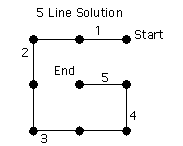
Now, can you do it with 4 lines?
Now, can you do it with 3 lines?
Now, can you do it with 1 line?
Once a user thinks "out of the box" they can solve the problem more easily. How creative one
thinks, leads to many "other" solutions. This exercise hopefully helped participants be
more creative in their approaches to solving the design challenges.


